
COS Pre-production: Turning Ideas Into a Plan
You sit down to write. You have a topic. Something you have been meaning to cover for weeks. An hour later you have four hundred words, two deleted paragraphs, and a growing sense that you are not sure what the piece is actually about.
The instinct is to call this a writing problem. It is not. It is a planning problem that only becomes visible during writing. You did not start without words. You started without a plan. No clear core idea, no defined reader, no decided angle. Writing exposed the gap. It did not create it.
Pre-production is the part of the Content Operating System that closes that gap before you open the draft.
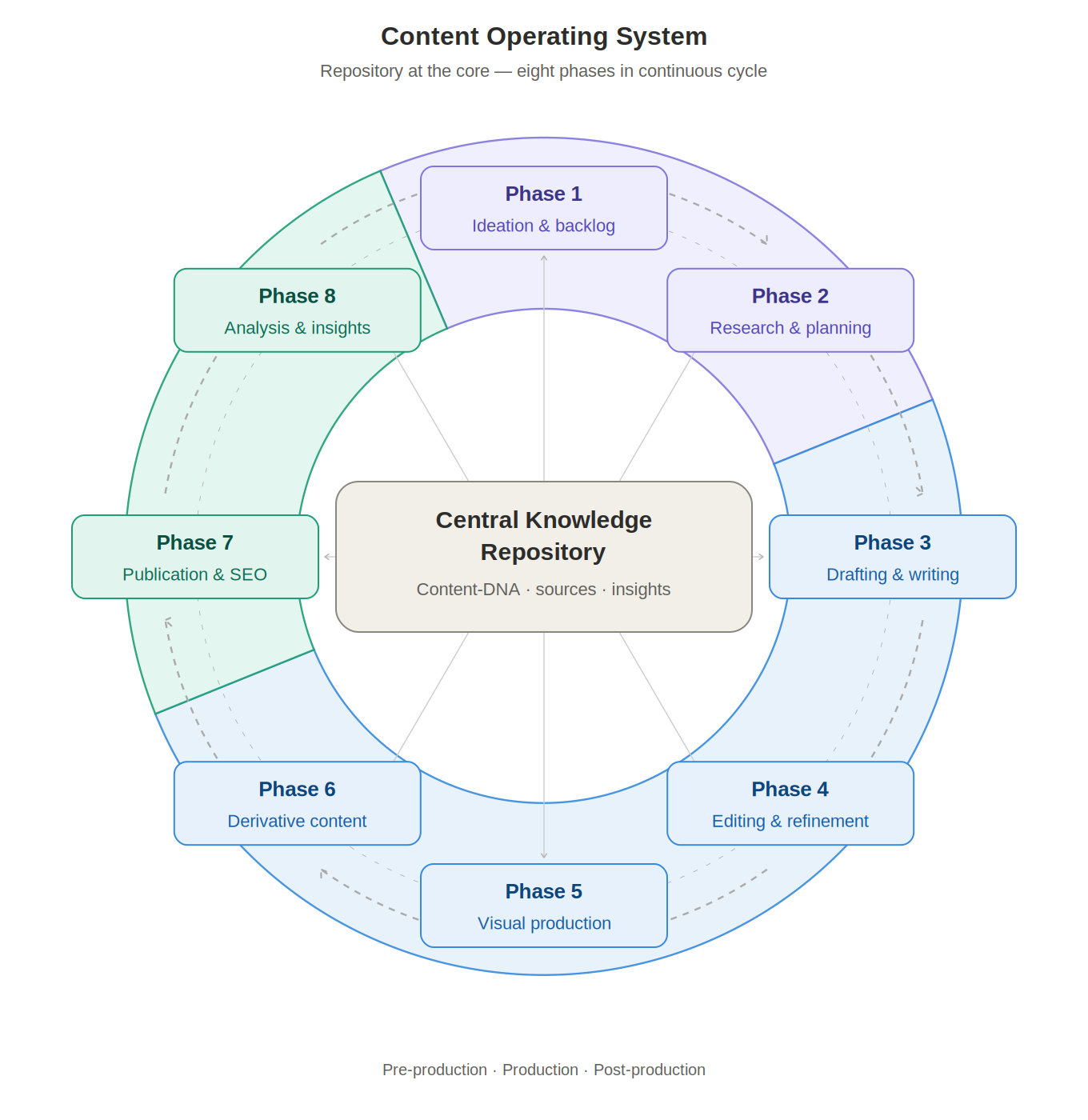
Pre-production turns a raw idea into a plan production can use
Pre-production is the architectural phase of a Content Operating System, and the first of its three operational groups. If you have not seen how the three fit together, the overview sets out the whole picture.
Its job is narrow and specific: take raw input, an idea, observation, question or something you read, and turn it into a validated plan that can enter production without ambiguity.
Everything downstream depends on the quality of that plan. A draft is only as clear as the brief behind it. An edit can fix sentences, but it cannot supply a core idea that was never decided. By the time a missing angle becomes visible, you are already several phases deep and reworking instead of writing.
The phase that feels optional is the one that costs most when skipped
Pre-production is the most frequently skipped phase in informal workflows, and the most consequential when skipped. It feels like overhead. You have the idea, you are eager to write, and planning looks like friction between you and the page.
It is the opposite of friction. An article that begins without a clear core idea, a defined audience, and a specific angle can still be finished. But it will not be effective, and it will cost more time in editing than the planning would have cost up front.
Skipping pre-production does not save the work. It moves the work to a later phase, where it is more expensive to do.
This is the phase that benefits most from being made explicit, and the one creators most resist making explicit.
Pre-production validates against your Content-DNA, not your instinct
Pre-production does not run on its own. It runs on the Content-DNA in your Repository. Your voice, audience, and the standards you defined before building any group.
That is what validated means here. Not validated against your taste on the day, but against a reader and a standard you decided in advance. If you have not established your Content-DNA yet, start there. This phase has nothing to validate against until you do.
Pre-production covers two phases: managing the ideas that feed it, and developing a chosen idea into a complete brief. The rest of this page breaks down how each one works and what each one should produce.