The Digital Product Ladder: What Comes After Your Free Offer
You have built a free product. People are downloading it. Your list is growing, slowly but steadily. And now the question that was always coming has arrived: what next?
This is where most solopreneurs pause longer than they should. Not because the options are unclear, but because there are too many of them. A paid ebook. A mini-course. A membership. A workshop. A template pack. Everyone seems to have a strong opinion about which one to choose, and the opinions rarely agree.
The options are real and the opinions about them are loud. What is missing is a way to weigh them that starts from your situation: one person, limited hours, a platform still being built.
The ladder filters your audience, and that is the point
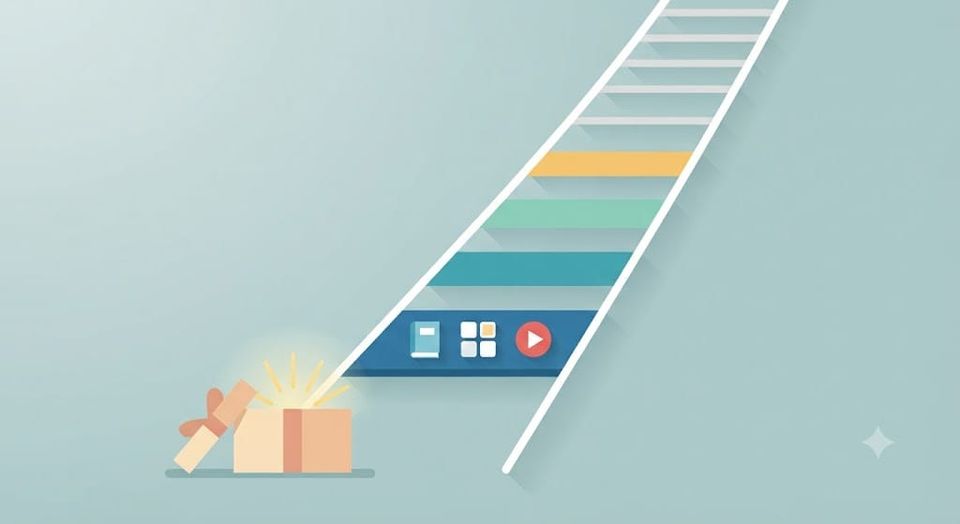
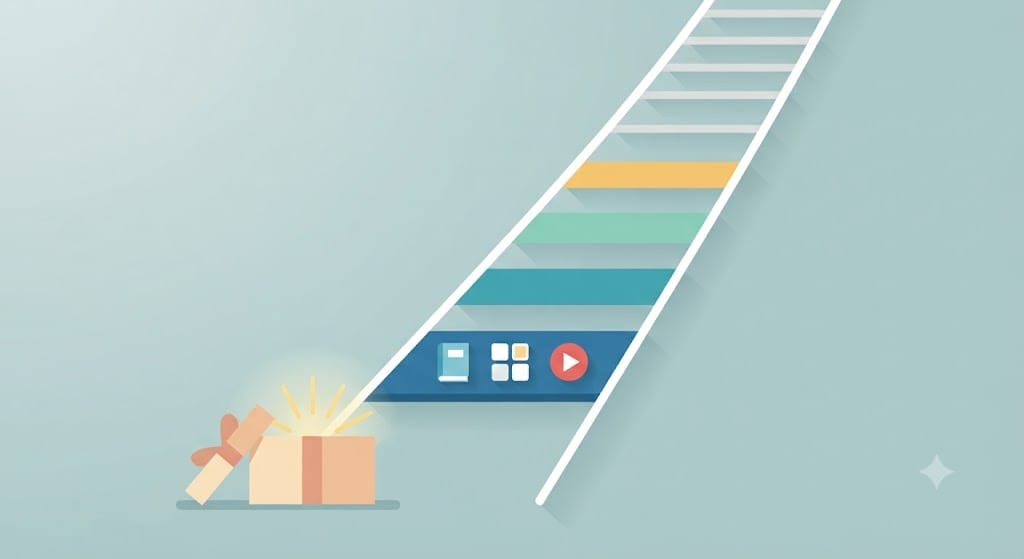
The idea behind a product ladder is simple. You offer something free to earn trust and build your list. Then you offer something paid at a low price point to convert a portion of that list into buyers. Then, for the readers who want more, you offer something at a higher price point that goes deeper.
Each step filters the audience. Not everyone who downloads your free resource will buy your first paid product. Not everyone who buys that will want your most involved offer. That is not a failure. It is how a sustainable product ecosystem works: a wide base that narrows toward the offers that require the most from both sides.
The free product is step one. You have that. And the answer to what comes next is smaller than most advice suggests: the right second step is not the most ambitious product you can imagine, but the easiest yes your reader can give.
The options, from easy yes to standing commitment
A paid ebook or guide is the most direct next step from a free resource. The format is familiar, the production cost is low, and the price point is easy to justify for a reader who already trusts you. The weakness is that ebooks are easy to ignore after purchase. Readers buy them with good intentions and never finish them. That is not fatal, but it does mean the perceived value often does not match the actual value you put into it.
A template pack or toolkit sells a shortcut rather than information: here is the structure I use, adapted so you can use it too. When your content is practical and system-oriented, this is a natural fit. The reader gets something they can apply the same afternoon, which is exactly what a systems-minded audience is after.
A mini-course earns its place when the transformation you are offering has a clear sequence: do this, then this, then this, and you will have achieved X. In effort and price it sits between a guide and a full course. The production overhead is higher than an ebook, but so is the perceived value, and completion rates tend to be better because the format implies progress.
A membership demands the most of you before it gives anything back. It is the most recurring revenue option, but it requires you to keep delivering value on a schedule, month after month. For a solo operator, that is a significant ongoing commitment. It makes most sense once you have a body of work and a community that is already engaged, not as a second step off the back of a free product.
A live workshop or cohort trades scalability for connection. You show up, people show up, something happens in real time. The revenue per participant is higher than most other formats, and the feedback you get is immediate and useful. The downside is that it does not scale without more of your time, and it is harder to repeat without feeling like you are running the same event over and over.
Notice what shifts as you move down this list. The price goes up, but so does what each option demands from you after the sale. That demand is the part most comparisons skip, and it is where the real decision lives.
What each option actually costs you
Price point and format are only part of the picture. The real question is what each option costs in time, maintenance, and ongoing commitment.
An ebook or guide is a one-time effort. You write it, format it, publish it, and it sits there. A template pack is similar. A mini-course requires more upfront work but is also largely set-and-forget once it is built. A membership requires ongoing production. A live workshop requires your calendar.
For a solopreneur who is still building the platform in parallel, ongoing commitment is expensive. Every hour spent delivering a membership is an hour not spent on the content that grows the platform in the first place.
The honest recommendation
If you are coming off a free product with a growing but still modest list, the smartest next step is a template pack or a focused paid guide, priced between ten and thirty euros.
Here is why. The price point removes almost all friction for a reader who already trusts you. You are not asking them to make a significant financial decision. You are asking them to make a small one. And a small yes is far more valuable than a large maybe, because it tells you something real: this person finds enough value in what I do to pay for it.
A template pack fits particularly well for a platform built around content systems and workflows. Your readers come to you for structure they can apply, not for inspiration. A well-built template pack delivers exactly that, and it positions your paid offer as an extension of your free one rather than a departure from it.
Start with the offer that converts easily, not the one that sounds most ambitious. A small product that sells is more useful than a large one that does not.
The membership and the live workshop are real options, but they belong further up the ladder. Build to them once you have evidence that your audience wants more depth from you, and once your platform can sustain the commitment they require.
The transition that matters most
The step from free to first paid product is the most important transition in your product ladder. Not because of the revenue it generates, which will be modest at first, but because of what it tells you and your audience.
It tells you whether the trust you have built translates into a willingness to pay. It tells your audience that you offer something beyond free content. And it gives you a foundation to build the rest of the ladder on, one step at a time, based on what your readers actually respond to rather than what you assumed they would want.
That foundation is worth more than a perfectly planned product suite that never gets built.
Read also: You Don't Need a Bigger Audience to Start Monetising