PACT, Cloudflare's anti-bot protocol, could lock out your AI tools
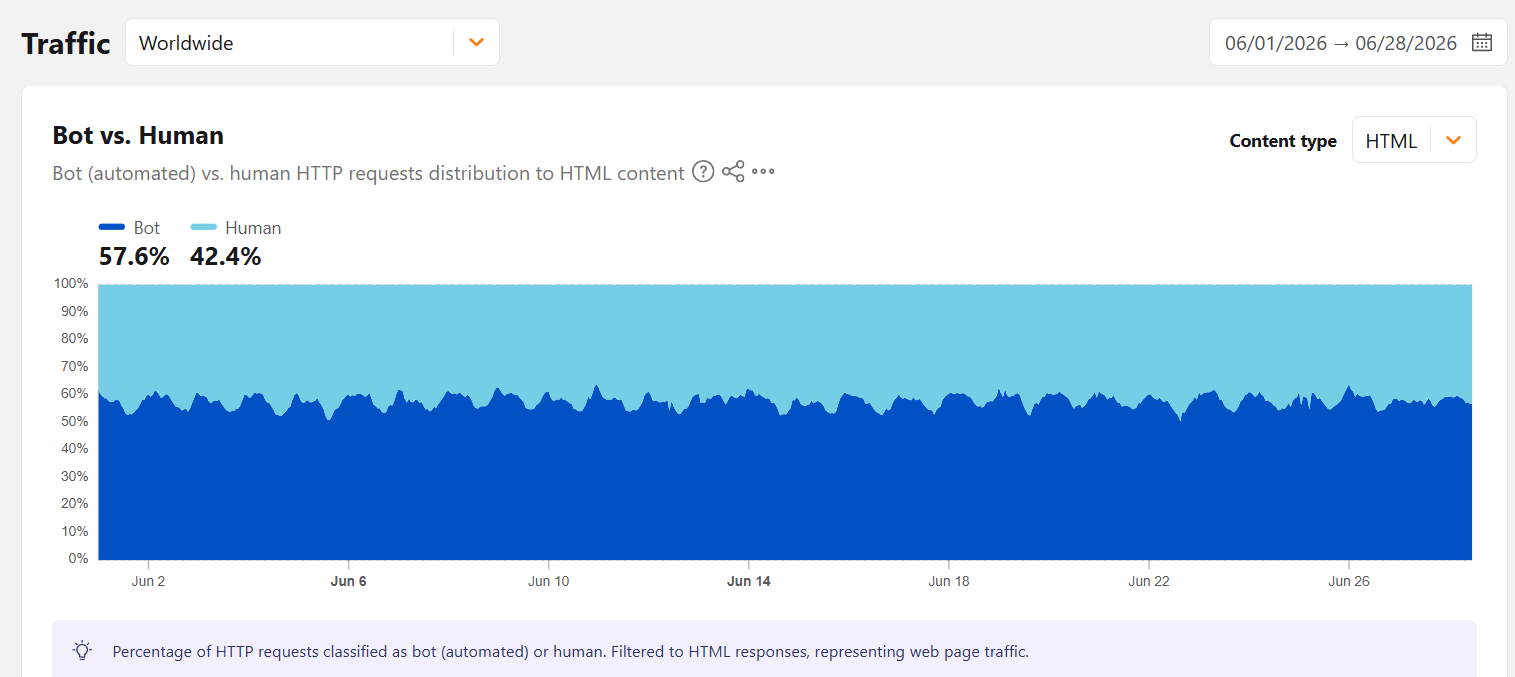
Last month, for the first time on record, most requests for web pages did not come from a human. In June 2026, Cloudflare Radar put automated systems at nearly 58 percent of requests to web page content, against just over 42 percent from people. As The Next Web reported, that crossover arrived about 18 months sooner than the company had predicted. And it is the reason a handful of the biggest names on the internet have just agreed on a new protocol to sort the traffic they want from the traffic they do not.
The protocol is called PACT, Private Access Control Tokens. If you publish for a living, it is easy to file this under security news and move on. That would be a mistake. PACT works in two directions at once. It makes your own site calmer, and it helps decide whether the AI tools you depend on are still welcome on everyone else's. Both things are true. They are the same mechanism seen from two sides, and the side you stand on is no longer yours to choose.
PACT is not a product you can buy, it is a proposal you should understand now
There is no rollout. Cloudflare announced PACT on 22 June together with Chrome, Firefox, Edge, and Shopify, and what they announced was an intention: to develop the protocol and submit it for standardisation. No standards body has been named, no timeline published, no deployment scheduled.
That sounds like a reason to wait. It is the opposite. A protocol that reshapes who reaches your content is most worth understanding before it hardens into infrastructure, not after. By the time it ships, the decisions that matter to you will already have been made by other people.
The mechanism itself is simple enough to hold in one hand. A site that already knows you are a real person, your email provider, say, can hand your browser an anonymous token. Your browser shows that token to other sites as proof that a human is in the loop, without revealing who you are. As TechTimes describes it, the receiving site learns only that someone trustworthy already vetted this traffic, and nothing about your identity, your history, or your device. It replaces the CAPTCHA and the forced login with a piece of cryptography. For the person browsing, it means less friction. That part is genuinely good news.
You are not one party in this story, you are two
Most coverage treats PACT as a thing that happens to website owners. For you it is more complicated, because you are never only a website owner. You are also a heavy user of tools that the web increasingly reads as bots.
Think about an ordinary week. An AI agent visits a site in your name to pull research. Perplexity fetches sources for a piece you are drafting. A curation agent does the job Google Alerts used to do. A summariser digests a competitor's latest article. Every one of those workflows is automated traffic arriving at someone else's site. Under PACT, that traffic falls into one of two buckets: it carries a valid token, or it does not.
Here is the part worth being precise about, because the easy version is wrong. PACT does not block your tools. It sorts them. The protocol is explicitly designed to let authorised agents through, not to shut automation down. As The Next Web notes, the initiative does not aim to block all automated traffic, because for many AI agents there is still a human somewhere in the loop with a legitimate reason to be there. A tool with a token passes more smoothly than it does today. A tool without one meets the same walls it already meets. What changes is not whether your tools work. What changes is that the difference between the two now runs through a credential you do not issue.
Your own site gets quieter, and that quiet has a cost
Now turn to the reassuring half, because there is one, and it is real. If you publish on Ghost Pro, you do not have to do anything. Ghost Pro already runs on Cloudflare, and Cloudflare manages these settings, not you. If PACT is ever woven into that network, your site benefits without you lifting a finger. Readers on Chrome, Edge, or Firefox would be recognised and waved through. For WordPress publishers the picture asks slightly more: you run your own infrastructure, so activating Cloudflare is a choice you make rather than one made for you.
But read the Ghost Pro situation again, because the comfort hides something. Not having to do anything also means not being able to do anything. You cannot set which agents are welcome on your own site. You cannot tune the policy. The carefree part of Ghost Pro is doing real work in that sentence: no worry, and no control. The same arrangement that spares you the hassle also quietly removes your hand from the dial.
That is not a complaint about Ghost Pro, which is doing exactly what you pay it to do. It is the first visible edge of a larger shift, and it points straight at the real story.
The power to decide who counts as trustworthy is moving away from you
The loss of control over your own site and the dependence on tokens for your tools are not two separate problems. They are one shift, seen from two angles. The authority to decide who is trustworthy, which human, which bot, which agent, is moving off individual websites and onto the infrastructure companies that issue the tokens.
Cloudflare's announcement never quite says who those issuers will be. It speaks of sites with "strong knowledge of personhood", and leaves the obvious question hanging. Search Engine Journal puts it plainly: the detail was left out, and what it sounds like is a third-party trust signal, which means gatekeeping could be shifting away from individual websites and toward the platforms, browsers, and infrastructure providers that decide which humans, bots, and agents are recognised as trustworthy. The same outlet points out the incentive that makes this hard to read as neutral. Cloudflare already underpins a large share of the web and increasingly hosts AI agents itself, so a protocol that manages agent trust runs conveniently through its own network.
The most honest framing of what PACT actually does comes from The Register, and it is worth keeping as the sentence you remember:
PACT divides internet traffic into welcome and unwelcome, something not easily reconciled with the notionally open web.
Read that against your situation. As a site owner, you lose some say over who may read your content. As a tool user, you depend on whether your software is deemed welcome. Different roles, same lever, and the same small set of hands on it. None of this is cause for panic. PACT may well make the web less annoying and more private, and those gains look real. It is cause for awareness, which is a different and more useful thing.
What to watch, and why it belongs on your radar rather than your to-do list
You do not need to act this week. Nothing about PACT changes your workflow today, and pretending otherwise would be its own kind of noise. What this asks of you is attention, not effort.
So know which of your tools actually go out onto the web on your behalf, because those are the ones a token regime will eventually sort. Watch how Ghost Pro and the rest of your stack absorb this as it firms up, since the decisions will arrive through them, not to you directly. And recognise the category you are looking at. This is infrastructure politics, the quiet kind that settles the rules of the road long before most people notice there are rules.
For anyone who chose to own their platform precisely to stay independent, that is the question PACT leaves on the table. Independent of whom, exactly, when the party deciding who gets through keeps moving further from your reach.