You write for Google. AI search works differently.
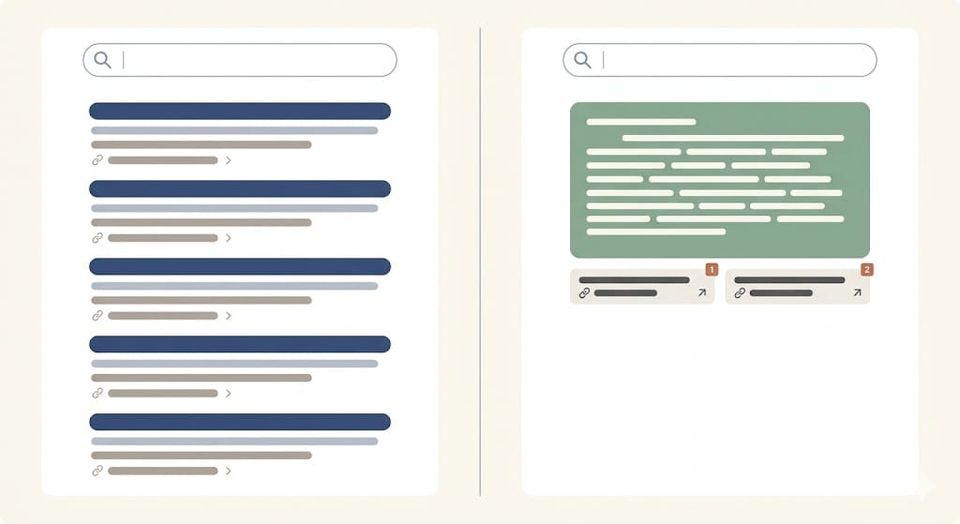
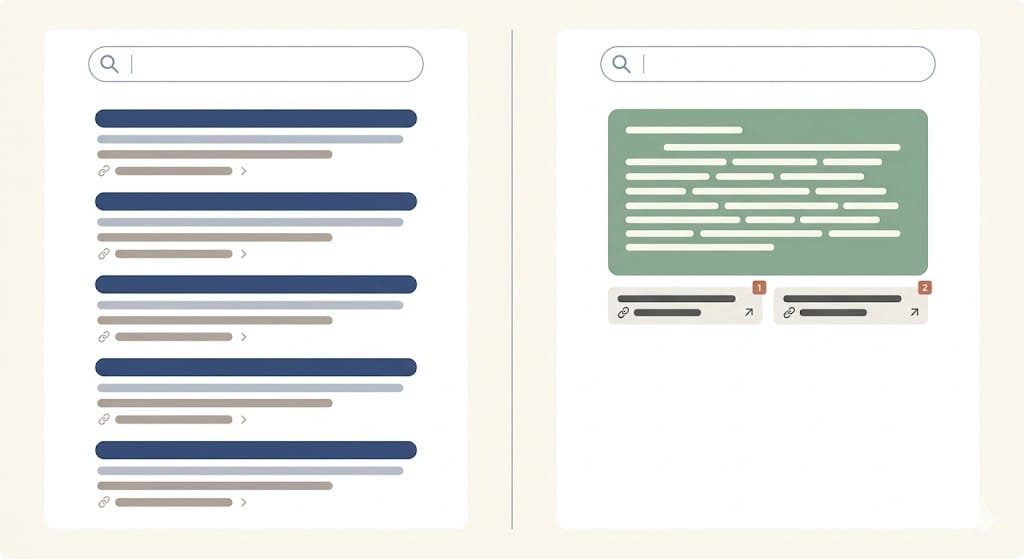
You search your own topic in ChatGPT. A solid answer comes back. Three sources cited. None of them yours. The article you published six months ago, the one that ranks on page one of Google, does not appear anywhere.
That is the new version of not being found. And the fix is not what you think it is.
AI search tools like ChatGPT, Perplexity, Google's AI Mode and Gemini do not return a list of links and leave the user to read. They synthesise. They pull from multiple sources, compose an answer, and cite the sources they used. Your content either ends up in that answer, or it does not. There is no page two.
This shift has a name: Generative Engine Optimisation, or GEO. Most of the conversation around it is aimed at marketing teams and enterprise brands. But the underlying logic applies just as directly to solopreneurs who publish independently on an owned platform.
Your discoverability in AI search depends on four things. Not on tricks. Not on a separate GEO strategy layered on top of everything else. On whether your content system already does what AI search rewards.
What AI search actually rewards
Traditional SEO rewarded websites that ranked. AI search rewards websites that get cited. The difference matters. A citation is not just a click, it is the AI system treating your content as a credible, useful source when composing an answer. That trust is not earned by publishing more. It is earned by being clearer, more specific, and more structured than the alternatives.
The signals that earn AI citations are the same signals that make content worth reading. Original observations. Specific experience. Clear answers to real questions. If your content system is built on those foundations, you are already most of the way there.
Who you help, and what you offer
The first thing AI search needs to understand about your platform is also the first thing a new reader needs to understand: who is this for, and what does it do?
Generic positioning is invisible to AI systems for the same reason it is invisible to readers. If your homepage describes what you do in vague terms, something that could apply to any content creator on any platform, the AI has nothing to work with. It cannot categorise you, cannot associate you with a specific problem, cannot cite you when someone asks a specific question.
The fix is the same whether you are writing for humans or machines: be specific about the audience you serve and the problem you solve. A solopreneur who publishes about content systems for other independent creators, specifically the workflow, the tools, the architecture, has a clearer identity than one who broadly "helps creators grow." That specificity is what gets you cited.
This applies at the article level too. Each piece should make its purpose clear early. What question does it answer? For whom? AI systems are not browsing, they are looking for content that directly addresses the query in front of them. The clearer your article is about what it is doing, the more likely it ends up in the answer.
Useful answers to real questions
AI search is heavily question-driven. People ask it how to compare options, what mistakes to avoid, what steps to take. Websites that publish useful, direct answers to those questions are the ones that get cited.
Content that earns AI citations tends to lead with the answer, not build toward it. A piece that spends four paragraphs establishing context before reaching the point is harder for AI systems to use than one that states the central claim early and then develops it.
That does not mean abandoning narrative or voice. The most citable content in 2026 is content that only you could write: original data, specific experience, a judgment call that only someone with real expertise would make. Generic, easily synthesised content gets deprioritised. The personal, specific, first-hand content that many creators hesitate to share turns out to be exactly what AI systems are looking for.
For a solopreneur content platform, this has a direct implication. The articles where you document what you actually built, what failed, what you changed, those are more citable than articles that explain general concepts. Your experience is a structural advantage, not just a stylistic one.
Trust signals that AI systems can read
Start with your About page. Most content platforms have one, but many treat it as a formality, a brief paragraph that satisfies the requirement without saying anything specific. In AI search, a detailed About page with verifiable experience is a trust signal. Who you are, what your background is, why you are writing about these topics. That specificity is what reduces ambiguity for an AI system deciding whether to cite you.
From there, the wider picture: AI search tools do not just look at content. They look at signals that indicate whether the content comes from a credible, identifiable source. Your author profile is connected to the content you publish. Accurate dates on articles matter. AI systems factor in recency, and a site that appears regularly maintained carries more weight than one that looks untouched. Contact information, transparent descriptions of what you offer, consistent identity across your platform, all of these contribute to what AI systems treat as credibility.
The clearer it is that a real person with real experience stands behind the content, the more confidently an AI system can cite it. Not because the machine cares about your personality. Because those signals reduce the risk of citing something unreliable.
Your platform is the foundation
AI search tools do not synthesise social media posts. They cite web pages. Specifically, pages that are public, crawlable, and clearly structured. Your Ghost site qualifies. Your LinkedIn posts do not.
This does not mean social media is worthless for discovery. It means that AI-driven discoverability runs through your owned platform. The articles you publish on your own domain, with consistent structure, clear authorship, and internal links connecting related content, are the ones AI systems can find, read, and cite.
Internal linking matters more than many content creators realise. A group of interlinked articles covering a topic from multiple angles — your content clusters — gives AI systems a map of your expertise. Each piece strengthens the association between your platform and that subject. A platform where articles sit in isolation gives AI systems much less to work with.
Ghost's technical foundation already supports the basics: HTTPS, fast loading, clean HTML. What you control is the content architecture on top of that. How your articles connect. Whether your most important pages explain what you do clearly.
Start here: open your five most-read articles and check whether they link to each other. If they do not, fix that before anything else.
What this means for your system
GEO is not a separate discipline that sits next to your content system. It is a diagnostic. The signals it rewards either emerge naturally from a well-built system, or are absent from one that was built without them.
If your platform is scattered with an unclear positioning, isolated articles, thin authorship signals, the problem is not that you need a GEO strategy. The problem was there before GEO showed up.
The shift to AI search is not a reason to rebuild everything. It is a reason to look honestly at whether your content system does what you built it to deliver. Fix that and you will improve your visibility in every search environment, not just AI.
Bottom line
GEO does not require a new strategy. It requires an honest look at whether your content system delivers what you built it to deliver: a clear identity, specific content, and a platform that connects its own pieces. If it does, you are already most of the way there.
Read next: You don't have a content problem. You have a selection problem.