The two questions every piece of content has to answer before you write it

This article builds on You don't have a content problem. You have a selection problem. The argument there is that AI doesn't solve a content problem — it exposes a selection problem. This article works out the two questions that make selection practical.

You are three paragraphs in and the piece isn't going anywhere. The idea seemed clear when you started. Now it doesn't. You keep writing because stopping feels like waste. You have already spent the time, opened the document, maybe briefed an AI. So you finish it. You publish something. And you wonder why it didn't land. The problem isn't the writing. The problem is where the decision happened.
Moving the decision point to before you start changes the dynamic entirely. The two questions are not a quality checklist you run at the end. They are a gate at the beginning. A piece that can't pass them doesn't enter your workflow at all.
Question one: which concrete question does this answer for my reader?
Not a topic. Not a theme. A question.
The difference matters. "Content systems for solopreneurs" is a topic. "How do I stop my content ideas from disappearing before I can write them?" is a question. One is a category. The other is something a real reader is actually trying to figure out.
If you can't state the reader's question precisely, you don't have a content idea ready to write. You have the outline of one. That is fine — put it back in your ideas pile and let it develop. But don't start writing yet.
The test is specificity. A good reader question has a person behind it — someone with a specific situation, a specific gap, a specific frustration. If your answer could apply to any reader in any situation, it isn't specific enough.
One more thing: the question has to belong to the reader, not to you. "I want to explain how content systems work" is your agenda. "How do I build a content system that doesn't fall apart after two weeks?" is your reader's question. Those are not the same piece. The first is you sending. The second is your reader looking for something — and finding it.
Question two: what can my reader do differently after reading this?
This is the harder question, and it is the one most content fails.
"Understand better" doesn't count. Neither does "think differently about" or "have a new perspective on." Those are outcomes for the writer, not the reader. They describe what the piece does for you — it lets you feel like you have contributed something — not what it does for the person who spent ten minutes reading it.
What counts is something the reader can act on. A decision they can now make. A step they can take this week. A mistake they will avoid because they saw it clearly for the first time. Something concrete enough that, if you asked the reader a month later, they could point to it.
That concreteness is also a diagnostic tool. If you struggle to answer question two, it usually means one of two things. Either the piece is genuinely too abstract — it argues a position without ever landing in practice. Or the piece is trying to cover too much ground, and the actionable core is buried somewhere in the middle.
Both are fixable. But you want to find that out before you write the piece, not after.
What to do when a piece fails the filter
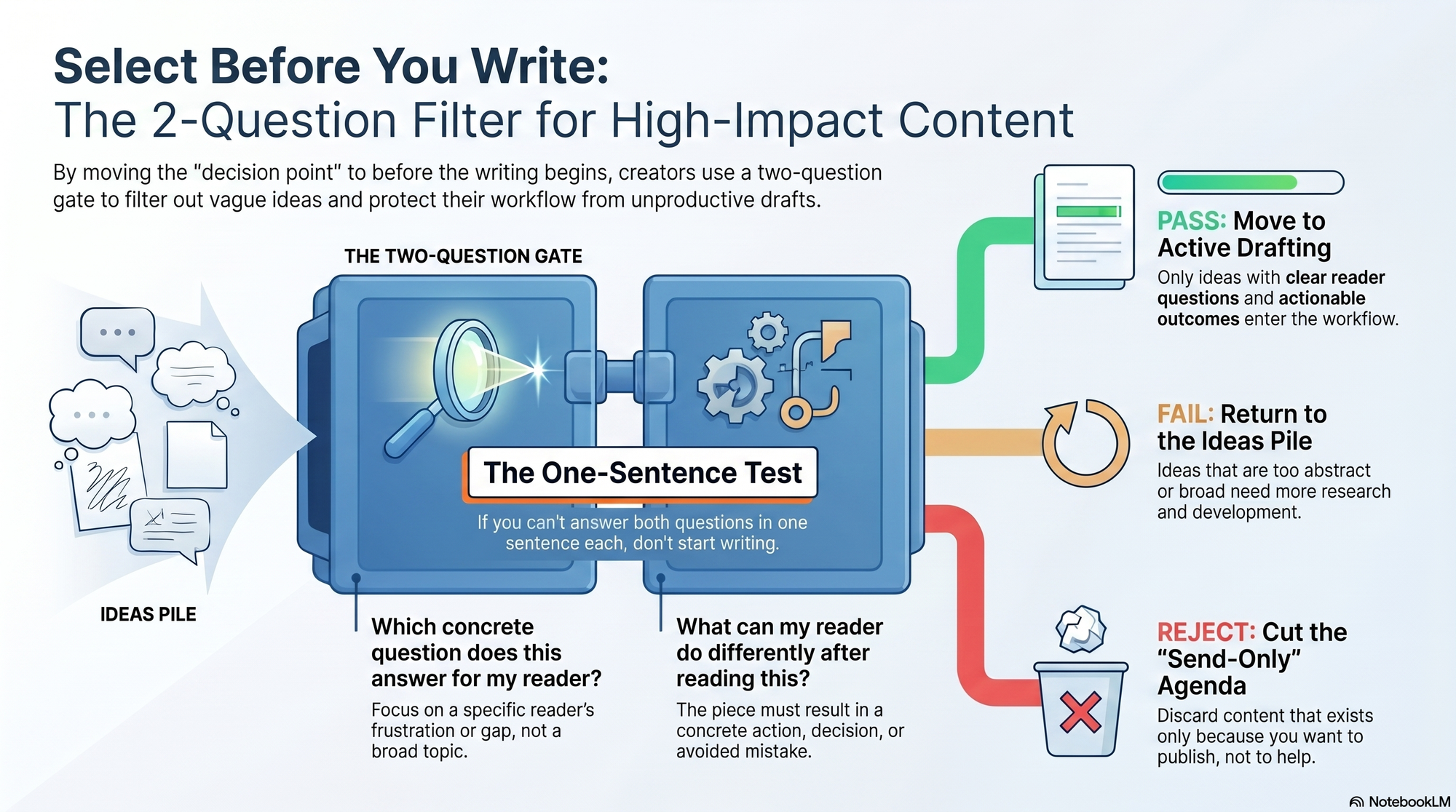
Not every idea that fails these questions is a bad idea. Some pieces need more time in the ideas pile before they are ready. The reader question isn't clear yet because you haven't thought it through enough. The actionable outcome isn't visible yet because you haven't done the research.
That is a different situation from an idea that will never pass the filter — content that exists because you wanted to publish something, not because your reader needs it. Those pieces you cut. The ones that need more development you keep, and you let them develop.
The practical discipline is to keep both questions visible in your workflow. Not as a reminder you occasionally consult, but as a required field. Before any idea moves from your ideas pile into active drafting, both questions need a clear answer. One sentence each is enough. If you can't write those two sentences, the piece stays where it is.
The filter doesn't make content harder to produce. It makes it harder to produce the wrong content.
That is the point. A selection-first system doesn't slow down your workflow — it protects it from filling up with work that doesn't build anything.
Next in this series: why your content calendar is lying to you — and how to rebuild it around selection criteria instead of publication dates.