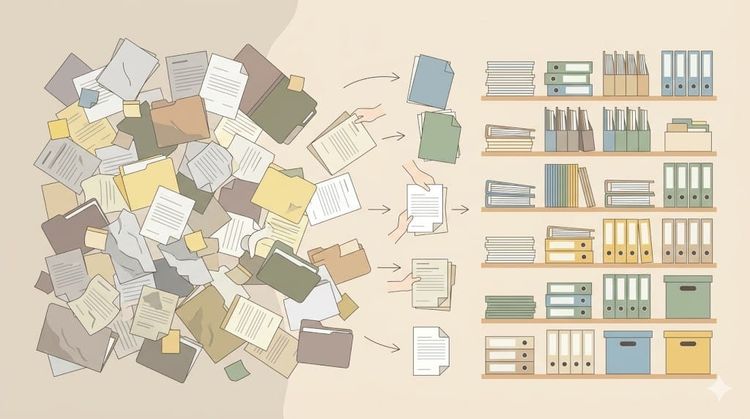
You don't have a content problem. You have a selection problem.


You've scheduled twelve posts for the next month. Drafted in a day, polished in an afternoon. The calendar looks full. The workflow feels tight.
And yet.
Something is off. Not with the output, but with what the output is for. Most of it exists because you needed to publish something. Not because your reader needed to read it.
AI didn't create that pattern. It just made it faster and cheaper to repeat.
The real shift AI forces
Here is what AI actually changes: it removes the last credible excuse for not going deeper.
Before AI, "I don't have time" was a legitimate answer when someone asked why a piece wasn't better researched, better argued, more useful. That answer is gone now. If AI saves you three hours a week on production, and you spend those three hours producing more content at the same depth, you have made a choice. You chose volume over value. And you made that choice deliberately, even if it didn't feel that way.
The shift AI forces is not from slow production to fast production. It is from producing to selecting. The question is no longer "how do I make this faster?" It is "should I be making this at all?"
What selection actually means
Selection is not quality control at the end of the process. It is a filter at the beginning. Before you open a document, before you brief the AI, before you block time in your calendar.
It comes down to two questions that every piece of content has to answer before you write it.
Which concrete question does this answer for my reader?
Not a general topic. Not a theme. A question. The kind a real reader would type into a search bar or bring up in a conversation. If you can't name it precisely, you don't have a content idea. You have a subject.
What can my reader do differently after reading this?
Not "understand better" in a vague sense. Something specific. A decision they can make. A step they can take. A mistake they can avoid. If you can't answer that either, the piece isn't ready to write. It might not be worth writing at all.
These are not comfortable questions. The gap they expose, between what you want to publish and what your reader actually needs, is where most content fails quietly.
Why the pressure to publish works against you
Solopreneurs carry the visibility pressure alone. There is no team producing content in the background, no brand machine keeping the channels warm. If you stop publishing, the silence is yours.
That pressure turns publishing into a signal of presence. You publish to prove you are still here, still active, still worth following. The content becomes secondary to the act of putting something out.
AI makes this worse because it lowers the effort threshold. When a piece takes a day to write, the friction of starting is itself a selection mechanism. You think carefully about whether it's worth writing. When it takes an hour, that friction disappears. And with it goes the natural filter that friction created.
The result is a calendar full of content that doesn't build anything for the reader, and doesn't build anything for you either.
The decision point moves earlier
The fix is not to publish less for its own sake. It is to move the decision earlier in the process.
Before any piece enters your workflow, it needs to pass the two questions above. Not as a formality. As a real gate. If a content idea can't answer both questions clearly, it doesn't move forward. It goes back into the ideas pile, or it gets cut.
That discipline also changes what AI is for in your system. Instead of using it to produce more content faster, you use it where depth is created: research, analysis, synthesis, sharpening an argument. The production step gets faster. The selection step stays hard. And stays yours.
The value in content has shifted. Not from making to distributing, but from making to choosing. Every solopreneur can publish more now. The ones who build something are the ones who publish better.
That is the competitive advantage AI actually creates. Not for the people who use it to produce more. For the people who use it to go deeper on less.
Next we will look into detail at The two questions every piece of content has to answer before you write it