Google's Q1 2026 AI Strategy: Building the System You Work Inside
I've been watching the AI announcements come in since January. Week after week, each one looking like just another product update. New model. Deeper integration. Smarter assistant.
At some point I stopped reading them as separate stories and started reading them as a sequence. That shift changes what you see.
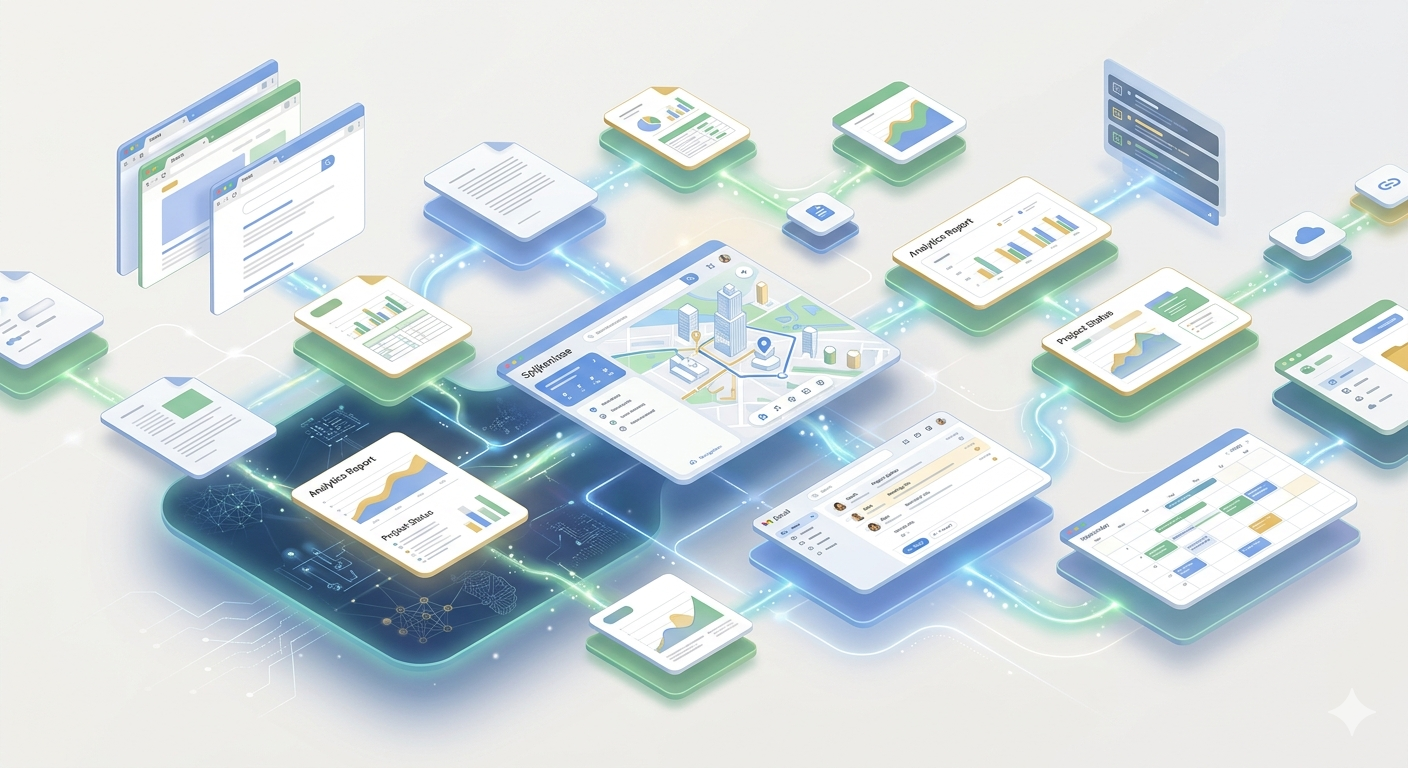
What looks like a steady stream of incremental improvements is, when you take Q1 2026 as a whole, a coordinated roll-out. Step by step, Google is not just improving AI. It is embedding it as a system layer across its entire ecosystem.
A Three-Phase Roll-out Hiding in Plain Sight
The key to understanding Google's strategy is not in any single announcement, but in the order of them.
In January, the focus was on context. Google expanded what it calls Personal Intelligence, connecting AI more deeply to Gmail, Chrome, and its core assistant experience. The system began to understand not just what you asked, but what you were doing. Across applications, not just within one.
In February, the emphasis shifted to capability. Upgrades across the Gemini family — stronger reasoning, better creative tools, improved handling of complex multi-step tasks — strengthened the engine behind everything else. The system became more capable of doing what the context layer had already learned to anticipate.
In March, the two converged in integration. Gemini was embedded across Workspace, Chrome, Maps, and Search. Real-time interaction, multi-modal input, cross-tool context. What had been separate features began operating as a unified layer.
This is not a product cycle. It is an architectural roll-out.
Gemini Is Becoming Infrastructure
With this foundation in place, Gemini is no longer just an AI model. It is becoming infrastructure.
It operates across documents and spreadsheets, search and browsing, mobile devices and third-party applications. But the important shift is not where Gemini appears. It is how it behaves. It carries context across environments, connects actions between tools, and increasingly operates as a continuous layer rather than a discrete interface you open and close.
That is what defines infrastructure. Not something you use. Something everything else runs on.
From Answers to Actions
At the same time, Google is pushing beyond AI that simply responds.
New capabilities across devices and services allow the system to take action. Tasks that once required manual execution — organizing information, initiating workflows, navigating between interfaces — are increasingly handled by the system itself.
This is the shift to agentic behavior. But Google's version of it is tightly bound to its own ecosystem. Actions are not happening in isolation. They are embedded within Google's products, which makes the system more cohesive. And more self-contained.
Personal Intelligence as the Core Layer
The most important element of this strategy is not any individual capability. It is the expansion of Personal Intelligence as the connective tissue.
By linking AI to user data across services, Google is building a system that does not just understand language but context. It knows what you are working on, what information is likely relevant, what actions are probable next. The interaction model begins to shift. Instead of prompting a system, you operate within one that is continuously adapting to your activity.
I use Gemini as part of my own research workflow, alongside other tools. The difference becomes most visible during research sessions where I move between sources quickly. Gemini does not wait for a question. It is already oriented toward what I am doing. Surfacing related material, connecting what I just read to what came before. That is a different kind of usefulness. It is also a different kind of presence. The system is not sitting at a distance. It is following along.
Workspace Is No Longer Just a Toolset
Within Google Workspace, this transformation becomes concrete.
Documents, spreadsheets, and presentations are no longer built step by step. They are generated from context. An email becomes a document. A dataset becomes an analysis. A rough idea becomes a structured output. The distance between thinking and producing contracts.
The user's role shifts from execution to direction. You are no longer building the artifact. You are shaping what the system generates.
Real-Time AI Changes the Interface
With the introduction of real-time capabilities — voice interaction, camera input, live context — Google is also redefining what the interface is.
AI is no longer confined to a text box. It becomes something that operates continuously across modalities. That reduces friction. It also increases presence. The system is no longer something you consult when you need it. It becomes something that is always available, always observing, always ready to act.
The Strategic Implication
When you take Q1 2026 as a whole, the conclusion is difficult to ignore.
Google is not building a better assistant. It is building a system that combines context. Who you are and what you do, what the AI can perform and where the AI is embedded. All within a single ecosystem.
The system becomes more valuable the more complete it is. That is a powerful dynamic. It is also one that rewards staying inside it.
That last point is worth holding onto as we look at what Anthropic and OpenAI are building. Because the question of what it means to stay inside a system — and what you give up when you do — turns out to be central to all three strategies.
This is the second article in a five-part series on where Google, Anthropic, and OpenAI are actually heading in 2026 — and what it means for how you work. The first article, the introduction to this series, is The AI Shift No One Is Explaining: Why Q1 2026 Changed Everything.